Dubai's commercial landscape has an abundance of businesses offering ISO certification services, which is very beneficial to buyers but can make the process of selecting a certification more difficult that it really should be. Understanding what actually separates a reputable certification company from one that's simply chasing volume makes a real difference to the value you get out of the process.Accreditation Is the First Thing to Check
A certification body's own accreditation is crucial, as any certification issued by a organization that's never accredited has less value before auditors, customers, and tender assessors. Verifying whether a certification organization has been accredited by an recognized accreditation body, and not simply claiming to issue international acknowledged' certificates, is the single most important first step to determine.
Find out the difference between Consultants and Certification Bodies
Many businesses mistakenly associate ISO consultants who aid in the establish a management system, with certification bodies, who independently inspect and issue the certificate itself. These are intended to be distinct roles, in order to maintain the independent audit and certification bodies. A company that provides both services under the same roof for the same client has a legitimate conflict concern that deserves to be discussed directly.
Expertise in the field is essential.
A company that is certified with real experiences in the industry you are in will ask sharper, more pertinent questions in the process of auditing and will not apply a generic checklist strategy to a company with unique operational realities. Construction, healthcare, and food production all involve different risks An auditor who is not familiar with the specifics in each area will offer a less effective assessment experience in general.
Go Beyond the Headline Price
Certification pricing in Dubai Prices for certification vary greatly, and the lowest cost isn't always the best choice, however it's important to be aware of the terms of the contract before you sign. Some quotations only cover the initial audit. Others exclude the ongoing surveillance audits required to maintain certification, which could turn a affordable deal into a significantly costly long-term commitment than company's transparent pricing.
Be Realistic About Turnaround Times
Companies under pressure to meet deadlines frequently due to the looming deadline, sometimes get drawn in by the promise of fast certification. An effective audit will take a certain minimum duration, regardless of how eager everyone involved is and particularly fast turnaround promises should be viewed with scepticism instead of relief.
Read Reviews From Businesses in Similar Sectors
Direct feedback from other Dubai-based businesses in a similar industry will give you a more reliable information than generic testimonials because it shows the way in which a certifier does in less-sophisticated areas of the procedure, such as scheduling, documentation support, and handling non-conformities found during audit.
Think about ongoing support, not Just the Certificate that you received initially.
Certification isn't a single event because maintaining it demands regular surveillance audits, and eventually renewal. A company that gives unambiguous, systematic support throughout the year helps to make that lengthy relationship considerably smoother rather than one focusing solely on securing the initial contract.
Request How They Handle Multi-Site or Multi-Emirate Operations
Businesses that have multiple sites within Dubai or across multiple cities, should ask what the company's policy is for multi-site inspections, as methods differ considerably among providers. Some companies provide an integrated auditing system that covers all of the sites on a schedule that is coordinated, other companies treat each site as a separate task, which can significantly affect both the cost and quality of the certification.
Be aware of the differences between UKAS, DAC, and Other Accreditation Marks
Certification bodies operating in Dubai might be accredited by several national accreditation bodies. This includes UKAS which is located in the UK or the Dubai's exclusive Emirates International Accreditation Centre, and recognizing which accreditation has the most weight to your specific customers and tender requirements is more important than assuming that everything accreditations marks recognised internationally.
Get Everything in Writing Before You Sign
Confidential statements about scope pricing, and timelines are significantly less valuable than documents that outline exactly what's included in the proposal, what happens if non-conformities are identified, and how the total cost will be for the entire three-year period of certification and not just the initial audit. A well-established company will have no hesitation providing this kind of detail prior to asking for a pledge.
Be awestruck by the impressions you get from Initial conversations
Beyond confirming credentials and pricing In addition, how a certificate company handles your initial inquiry usually reveals a lot about how they'll be treated once you've signed the contract. A company that responds to your questions without ambiguity, doesn't force to make a snap decision, and appears interested in understanding your business instead of simply selling a product is generally a more reliable long-term partner in comparison to one that focuses purely on signing quickly.
Monitoring for High-Pressure Sale Techniques
Certain certification organizations operating in the competitive market of Dubai rely on aggressive sales tactics, like artificial urgency around limited-time pricing or claims that their competitor is about to secure a certain time slot. True certification bodies aren't required to be relying on this type of pressure, because their value proposition is built around qualifications and track records more as a rapid closing sales pitches, which makes pushing itself a good warning signal.
The best choice for a certification provider in Dubai is a matter of confirming credentials in a proper manner, understanding what you're getting for your money, as well as valuing real sector experience over the lowest headline price in the sense that the certificate is only as dependable as the process used to produce the certificate. In the end, the businesses that get the most benefit from certification in Dubai aren't those who rely on the best price. They are those who have taken the time to review accreditations, comprehend all the nuances of the certification they're purchasing and pick a partner genuinely suited to their sector and size. These checks don't take long alone, but in combination they build a genuinely informed picture that helps protect against two most typical outcomes of a poor choice: an ineffective certificate or an costly ongoing relationship. A little extra attention upfront is always worthwhile over the duration of the multi-year certificate relationship that will follow. View the best ISO Consultants Dubai for site examples.
ISO 9001 Explained: Quality Management for UAE Businesses
ISO 9001 remains the most widely recognised management system standard globally, which is not surprising since it's built around a genuinely useful concept, that a constant quality results from consistently well-managed processes and not from good intentions alone. For UAE companies that are considering certification, understanding what the standard actually requires can help simplify an approach that is often more complex than it is.What ISO 9001 Is Actually Built On
It is at the core of it all. ISO 9001 asks a business to identify its primary processes, understand how they interact and then monitor whether they're working, and then refine them by systematically improving them in time. In lieu of dictating exactly how a business should function it offers a structure to ensure that any approach an organization adopts adheres to the same principles, is documented when it is necessary, and strictly adhered to.
What is the reason UAE Businesses Pursue It
Beyond its reputational benefit of the certification, many UAE businesses seek ISO 9001 because government and private sector tenders often list it as the prequalification criteria. Beyond the fact that it is a requirement when they implement it, companies that do the system correctly typically reap positive operational results, such as less frequent mistakes, more transparent accountability, and a more structured procedure for handling complaints from customers.
The role of top Management
One area that the standard stands most steadfast about is genuine leadership involvement, rather than quality management being entrusted to the compliance manager, which is completely detached from actual decision-making. Auditors are specifically looking for evidence that senior leadership understands and actively support the quality management process, instead of just signing off on it.
Risk-based Thinking is the foundation of the Modern Standard
The latest Version of ISO 9001 places considerable emphasis in identifying opportunities and risks relevant to a business's specific context, and not relying on the same checklist in all the specifics. This means a UAE construction company and a UAE software company, though both certifying against the same standard can end up having distinct quality management systems that reflect their unique risk profile.
The Customer-Focused Approach is Continuous Throughout the Standard
ISO 9001 repeatedly returns to the notion that quality means meeting customer demands as well as expectations. It's not only internal efficiency measures. Businesses that comply with the standard are required to have a proper system to know what customers want and how they're satisfied. They should not assume that internal quality check-ups are all that's needed to see the entire picture.
Its Certification Process Itself
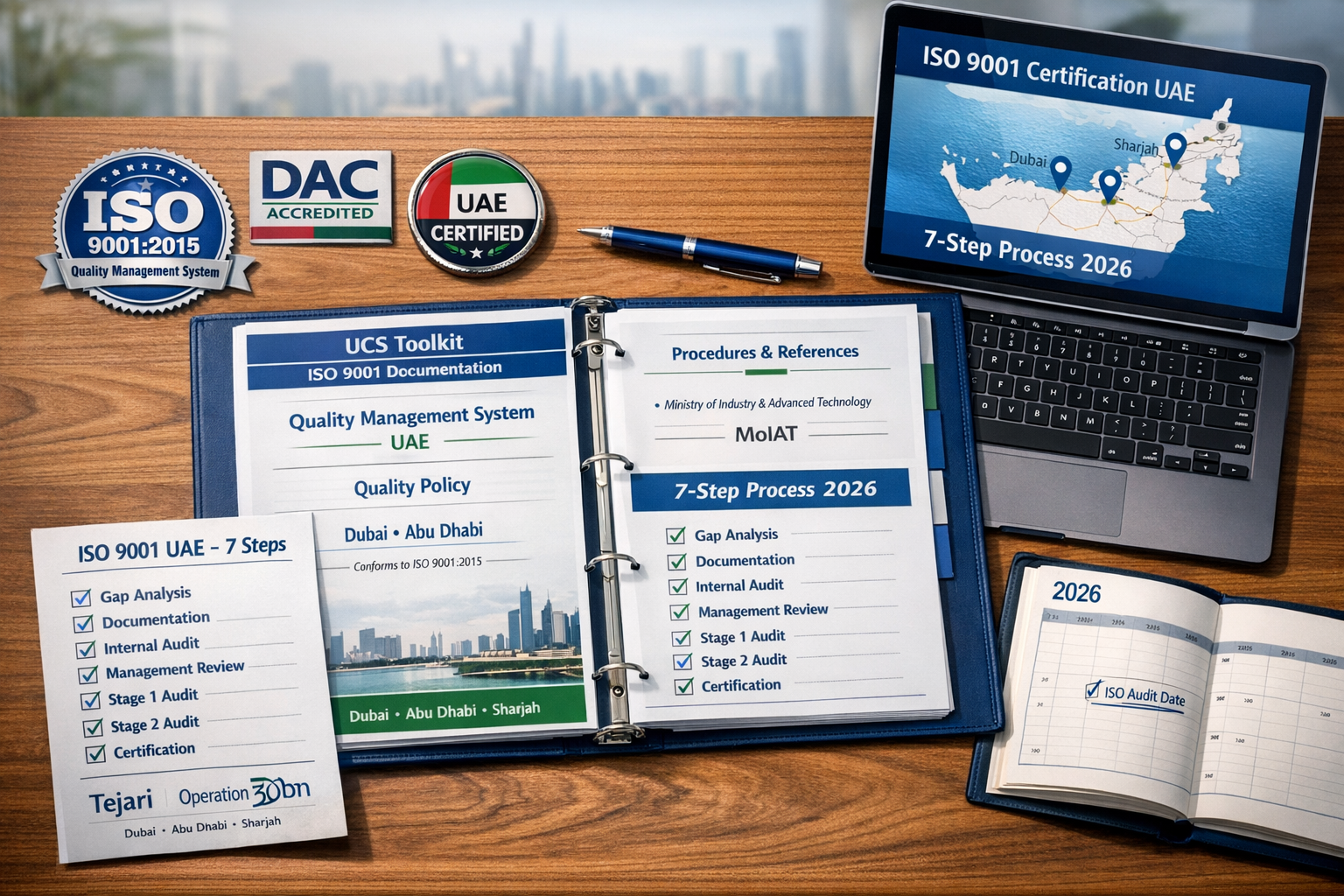
After having implemented the necessary procedures as well as documentation, certification includes an external audit conducted in two steps, starting with reviewing the documents and readiness, and then assuring that the system is actually operating as it is described. Certification is followed by regular surveillance audits, and finally a complete periodic audit of recertification about every 3 years to ensure that the system is in constant compliance.
Common Misconceptions You Should Clear Up
The most common misconception is that ISO 9001 requires enormous volumes documents, whereas the current version has reduced the amount of mandatory documentation substantially compared to older versions. It is more focused upon demonstrating real process control. Another common misunderstanding is that certifications guarantee that the product is of high quality, but in reality, it confirms that the company has a uniform approach to managing quality which is a significantly different but nevertheless a useful thing.
How It Differently Applyes Across Industries
A construction company that is implementing ISO 9001 will focus heavily on handover procedures for projects and managing subcontractors, while a professional services firm might be focusing more on client engagement and management of knowledge. The standard's flexibility in a variety of sectors is why it's a necessity in a wide range of UAE industries including manufacturing, retail and consulting.
The Role of Continual Improvement
ISO 9001 doesn't treat quality as a fixed destination but rather as a continuous cycle of monitoring effectiveness, identifying potential areas to enhance, and implementing improvements gradually. Organizations that fully embrace this mindset of continuous improvement, rather than considering certification as a one-time initiative, generally see more long-term, meaningful operating benefits from ISO 9001.
Get Your Team Prepared to handle the Cultural Shift
One of the aspects that's most often ignored associated with ISO 9001 implementation is the essential shift in culture, switching from informal, individual-dependent methods of working towards more consistent, structured procedures that don't depend on any one person's memory or judgment. Preparing staff for this shift as well as explaining the actual benefits instead of viewing it only as a compliance issue significantly improves the way it is implemented.
The reason the investment tends to Pay Off
Businesses that implement ISO 9001 thoughtfully, rather than just an exercise in paperwork to meet an external requirement, generally discover that the investment is rewarded due to fewer mistakes repeated over time, an improved internal accountability system, and the foundation is stronger for expanding operations as the enterprise grows. Benefits transcend the requirements of the certificate its own.
When and how ISO 9001 Interacts With Customer Complaints Specifically
The standard demands that companies be able to establish a proper, organized process for handling customer complaints and feedback. This means treating every feedback as an information point which can feed into improvement in the process instead of becoming forgotten and relegated to the back of the drawer. UAE businesses that design this feedback loop in the right way often come to realize that it's one of its most useful aspects of the entire management system, well beyond its role for assisting with the audit.
For UAE businesses who are considering whether ISO 9001 is worth pursuing, the honest answer usually boils down the question of whether the company truly wants effective, standardized processes. since the certificate itself actually a formal confirmation of that underlying operational discipline. For UAE companies that are truly committed to increasing their efficiency instead of simply obtaining one of the certificates, ISO 9001 offers a internationally recognized, tested approach to making improvements regular and not accidental. None of this requires abandoning those practices that have been proven to work inside a company. ISO 9001 is fundamentally about making it easier to implement and strengthen good practice rather than replacing it wholesale with a completely different system. If you think about it this way, a certification is an inevitable extension of good management rather than being a burden external to the business. It is, in the end, a framework built around the common sense that is consistently applied rather than anything mysterious. That above all else, is the main reason why it merits being considered with seriousness. Few other investments have such large, long-lasting value. Absolutely worth the time that it takes. Follow the most popular ISO Consultant UAE for blog tips.